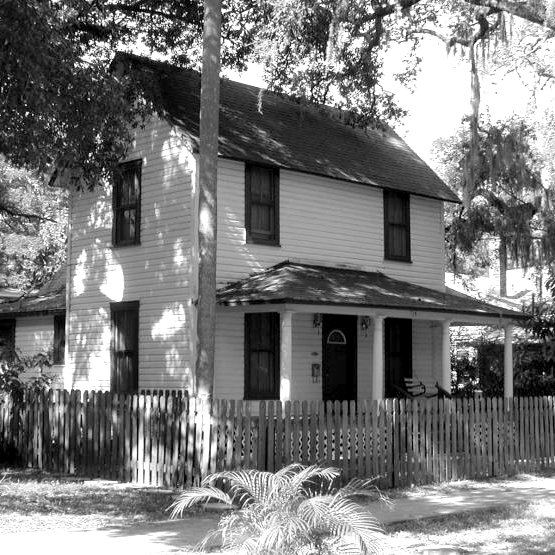
Around 1898, carpenter William Rawls built a modest wood-frame house near Round Lake in St. Petersburg. Today, that home offers a rare connection to the city’s early history and a reminder that important landmarks do not always belong to famous people.
Located at 734 Grove Street North, the Rawls House is an example of a traditional architectural style known as an I-house. These two-story homes were typically two rooms wide and one room deep, with a symmetrical front and a roof whose gables faced the sides. The design was common in 19th-century rural communities, where building an I-house could signal a family’s growing prosperity. The style even earned the nickname “Farmer’s Mansion.”
William Rawls was not one of St. Petersburg’s celebrated founding figures. He was a working carpenter who moved to the area from Georgia. Census records from 1910 list him as a single man who could read and write. By 1915, he had married Katie, and the couple raised two children in the house. Their descendants continued living there for generations, until 1989.
Eventually, the house stood vacant and deteriorated. It was even identified as one of the Uptown neighborhood’s eyesores, and city officials considered demolition. In an effort to protect the structure, its owner sought local historic landmark designation.
The Rawls House (pictured) is significant because it is the only known local example of an I-house and one of the city’s earliest surviving homes. Its story reminds us that St. Petersburg’s history was shaped not only by prominent leaders, but also by the working people who built homes, raised families, and helped communities grow.
Share Article: