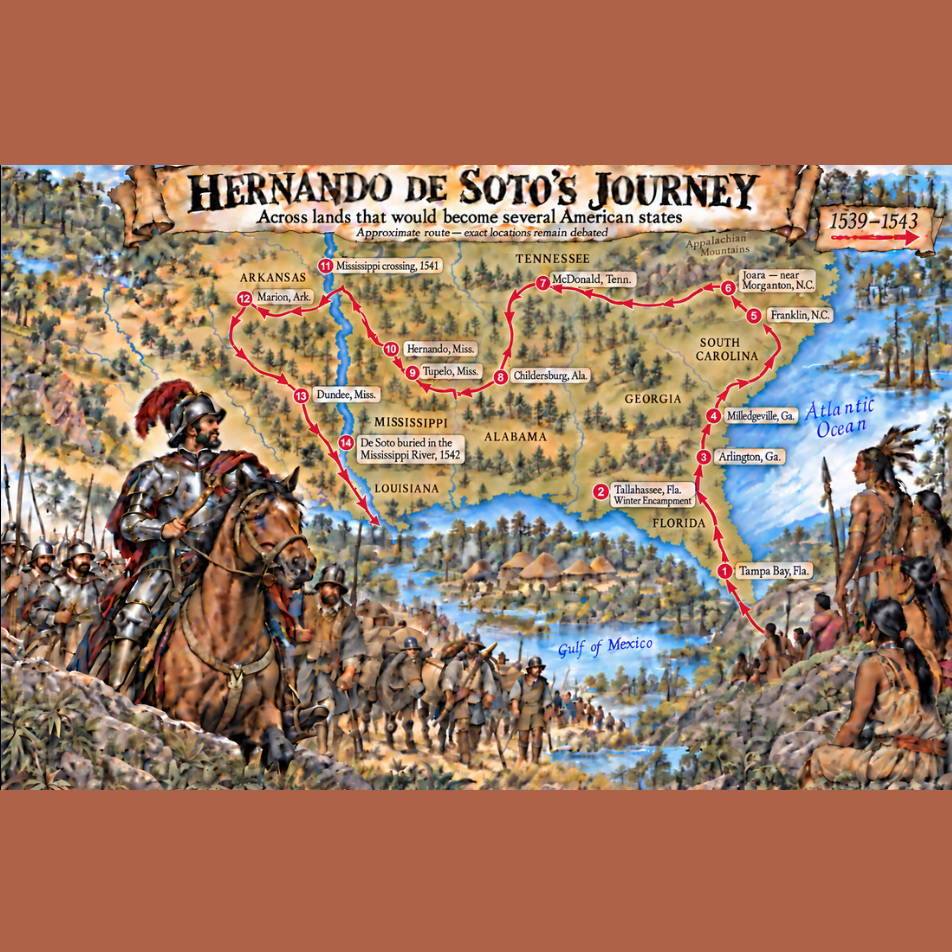
On October 6, 1539, Hernando de Soto and his expedition entered Anhaica, an Apalachee town in what is now Tallahassee. The arrival marked a violent encounter between Spanish invaders and a Native society that had occupied the region for centuries.
De Soto had landed in Tampa Bay in May 1539 with more than 600 people, including soldiers, enslaved people, craftspeople, and bureaucrats. After months of travel through Florida, the Spaniards moved north into Apalachee territory in search of wealth and resources.
The Apalachee understood the threat De Soto posed. As his army approached, they abandoned their towns. De Soto’s forces occupied Anhaica, using its buildings and food stores for their winter encampment. The occupation lasted until March 3, 1540.
The winter was far from peaceful. The Apalachee repeatedly attacked the Spanish from surrounding areas, while De Soto’s men used the town as a base. The encounter disrupted Apalachee communities and became part of the violence, disease, and upheaval associated with De Soto’s journey through the Southeast.
The expedition also stayed through the winter holidays. With twelve Catholic priests among the camp, they celebrated Mass in December 1539. Historians recognize it as the first documented Christmas celebration in the continental United States.
Anhaica has an archaeological story, too. In 1987, archaeologist B. C. Jones investigated a construction site in Tallahassee and discovered early 16th-century Spanish artifacts, including olive jar fragments, chainmail, crossbow bolts, and coins. The discoveries helped confirm the location of De Soto’s winter encampment.
The site reminds us that Florida’s history reaches back long before European settlement, and that archaeology can recover stories written records alone cannot tell.
Share Article: