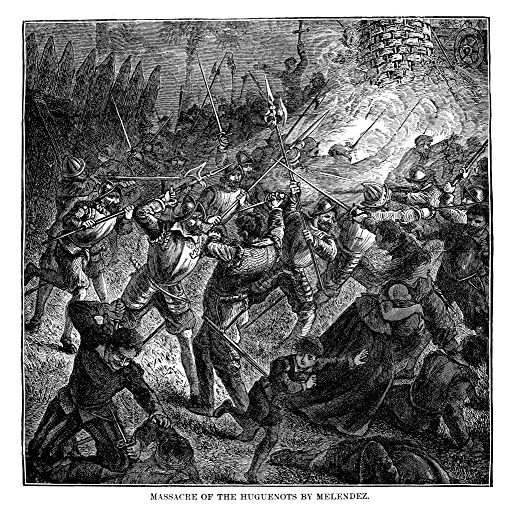
On October 12, 1565, one of the bloodiest episodes of early European colonization in Florida unfolded along an inlet south of St. Augustine.
Spanish Admiral Pedro Menéndez de Avilés had been sent to remove the French from Florida and establish a Spanish settlement. The French, led by Jean Ribault, had established Fort Caroline near present-day Jacksonville. Many of the French settlers were Huguenots, or French Protestants, creating both political and religious tensions with Catholic Spain.
In September, Ribault sailed south with his forces to attack the newly established Spanish settlement at St. Augustine. A hurricane scattered and wrecked the French ships along the coast. Menéndez seized the opportunity, capturing Fort Caroline while Ribault and other survivors remained stranded farther south.
Menéndez later encountered a group of shipwrecked Frenchmen at an inlet south of St. Augustine. On October 12, Ribault and his remaining men surrendered. According to the National Park Service, 134 Frenchmen were killed. The Spanish had already killed 111 Frenchmen from an earlier group at the same inlet, while 16 were spared for various reasons, including professing Catholicism or having skills the Spanish needed.
The inlet soon became known as Matanzas, a Spanish word meaning “slaughters.” The name eventually became attached to the Matanzas River and the nearby national monument that preserves part of this historic landscape.
The events at Matanzas helped secure Spanish control of Florida and ended the immediate French challenge to Spain’s claim to the region. Today, the site reminds us of the violence and competing ambitions that shaped Florida’s early colonial history.
Share Article: