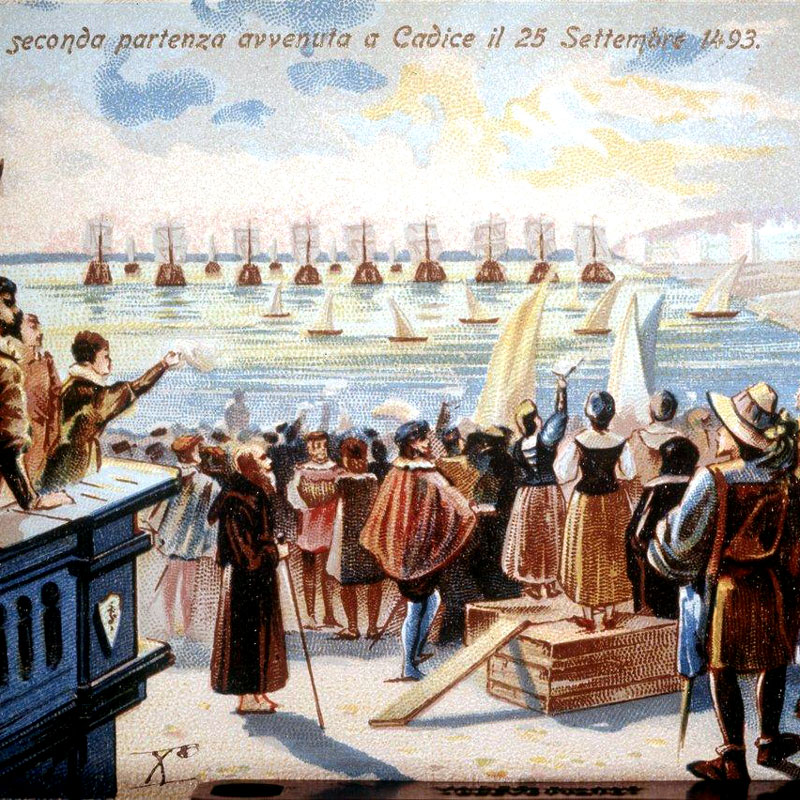
On September 24 or 25, 1493, depending on the source, Christopher Columbus departed from Cádiz, Spain, with a fleet of 17 ships and more than 1,200 people. That was quite a change from his first voyage, when just three ships crossed the Atlantic.
This time, the expedition was designed not simply for exploration, but to establish a permanent Spanish presence in the Caribbean. The fleet carried colonists, sailors, artisans, religious figures, animals, food, and other supplies needed to create settlements.
Among the ships were the Niña, which had returned from the first voyage, and the Pinta, which was probably the same ship that had crossed the Atlantic with Columbus in 1492. The fleet also included the flagship Marigalante.
The expedition reached the Caribbean in November, sighting the island Columbus named Dominica on November 3. From there, the fleet continued through the Lesser Antilles and eventually reached Hispaniola, where Columbus established the settlement of Isabela in January 1494.
The second voyage marked a major turning point. What had begun with three ships the year before had quickly grown into a large-scale colonial expedition, bringing hundreds of Europeans across the Atlantic and beginning a much more permanent Spanish presence in the Caribbean.
It was a voyage that would have consequences for the region and its Indigenous peoples for centuries to come.
Share Article: